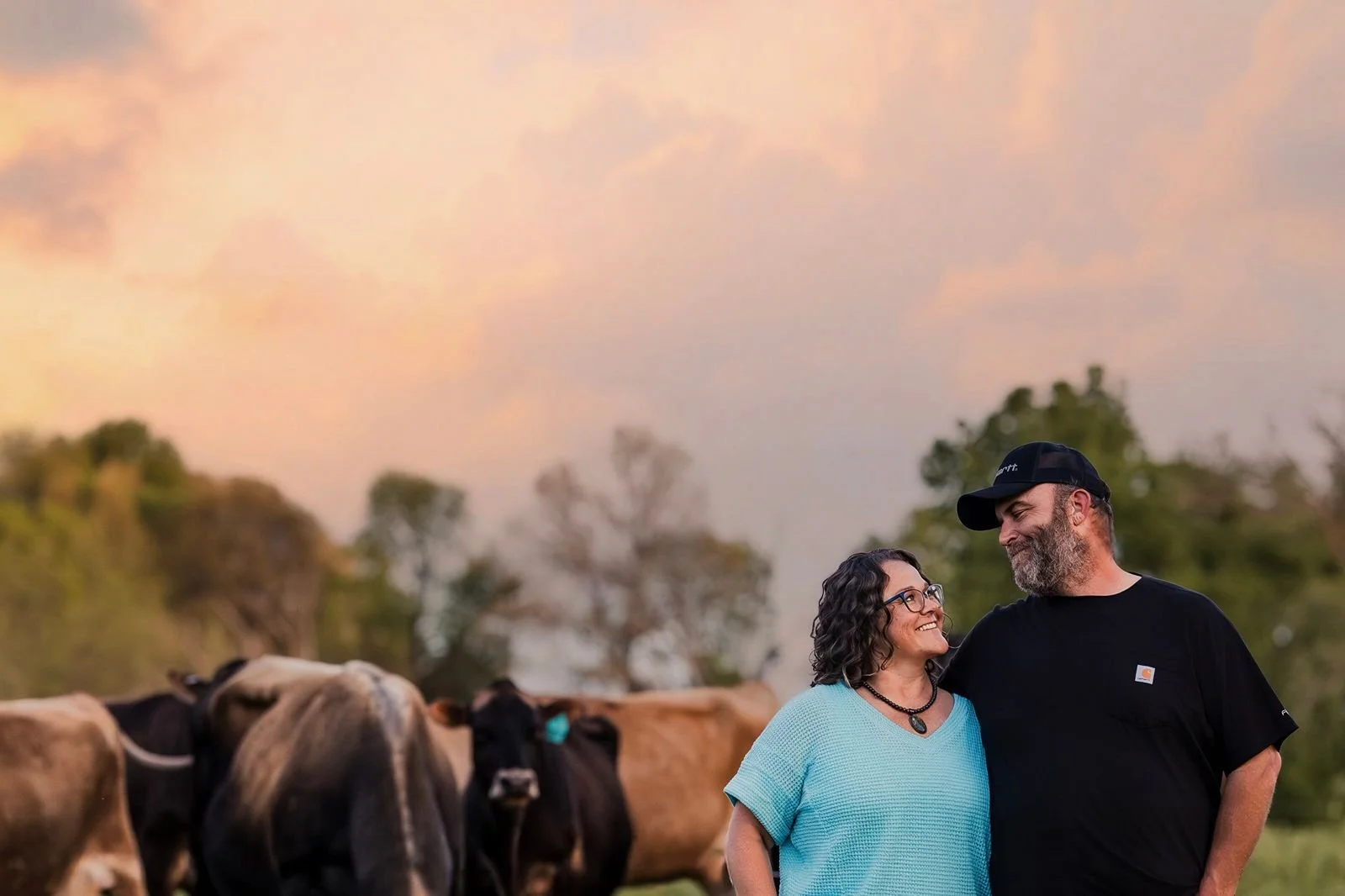
Today, Moxie Farms is a working regenerative farm where cows, hogs, goats, birds, bees, gardens, and orchards all work together. It's a piece of land that feeds dozens of families year-round. They come here for their food, but they also get to know the farm, the people who work here, and what goes into growing it. Pull in the driveway, and it feels like a different world, a little haven away from the city.
Long before any of that, it was an idea I couldn't put down. Back when my son was little, I'd sometimes escape to the library and read every issue of Mother Earth News I could find. When the library boxed up the old issues to give away, I took them home and read them again, over and over. Somewhere in those pages, a picture started to form: how amazing would it be to live on a piece of land where everything you needed was right there?
I had no land, no farming background, and no money behind me. This is the story of how that picture turned into a farm, and how the farm grew into a whole lot more than a place that produces food.
Raised on scratch cooking and hard work
For more than 20 years, my mom ran the only diner in the small town where I grew up. Everything was made from scratch, so I grew up around good, hearty food, and I was in and out of that kitchen constantly: stopping in after school and washing dishes long before I was old enough to be much help anywhere else. That's where my food life began.
I grew up around horses, and when I was about 12, I wanted riding lessons. Since nobody was going to pay for those, I went to a local trainer and begged and pleaded until she agreed to let me work for them. Pretty much every day after school, I did all the grunt work: cleaned stalls, fed and watered, and exercised horses. In return, I got a ton of training and an early lesson I've leaned on ever since: if you want something badly enough, there's usually a way to work for it.
Lessons in feeding a crowd
After high school, I went off to college as a math and science major.
While I was there, I worked at one of the biggest restaurant and nightclub operations at Lake of the Ozarks, where people hop from one waterfront bar to the next by boat.
We hosted every kind of big gathering you can think of: weddings, reunions, and everything in between. Before long, I had pretty much taken those parties over. I got really good at feeding a crowd and making a night feel like an occasion.
Then, in 1997, my first son was born. I kept working in restaurants, sometimes juggling three jobs at once. But I needed to earn more than restaurant work could pay, and I wanted to be home with my son. Somewhere along the way, it dawned on me that the skills I used every day could be put to work from my own kitchen instead, with my son right there beside me.
So I started cooking meals for families and delivering them to their doors. Meal planning wasn't really a thing yet, and neither was meal delivery, at least not where I lived. But people were busy; they wanted to eat well, and I knew how to cook. Before long, I was catering bigger occasions too: weddings, reunions, bar mitzvahs, and corporate events.
I was never trained as a chef. I'm a home cook and country cook at heart, and I cook the way I like to eat. Turns out, plenty of families wanted to eat that way too — my home-cooked meals got more popular every month.
But the more time I spent in the kitchen, the less I liked the ingredients I had to work with. Small farms and farmers' markets were hardly heard of around us back then, so I planted a garden and grew what I could myself: tomatoes, mostly, and the other crops I'd now call the “easy ones.”
The shopping list that changed everything
Around that same time, my mom got very sick. She had been struggling with her health for years, and now her liver was giving her real trouble.
The irony wasn't lost on me. Mom had spent 20 years in a kitchen where nearly everything was made by hand. But even she used ingredients like vegetable oil and bleached white flour every day, and over the years, that had caught up with her.
The doctor who talked about butter
At one of her first appointments, a physician did something I had never seen a doctor do: he talked about food. In my experience, doctors tend to send you home with a prescription rather than having a conversation about what's on your plate. But he knew she ran a diner, and he told her plainly that the hydrogenated oils were making things worse.
The margarine had to go, all of it. Any kind of butter would be an improvement, he said, but the better the butter, the better for her.
I doubt he ever knew what an impact that one conversation had on my life.
Until then, I had never once thought about where fat comes from, or that it could be better or worse depending on the animal it came from. But now finding a better, healthier way to source our food wasn't just a daydream anymore; it was about feeding my mom.
A four-hour grocery run
Eventually, I set the meal business aside, moved home for good, and picked up a few waitressing shifts so I could be there for my mom. Her doctors had given her a list of foods she needed in the cleanest form she could find, and tracking them down became my job.
For about a year, I drove a four-hour loop around the Kansas City area every week: meat from one small farm, milk from another, and whatever produce I could find in between. I'd come home with the car packed and prepare all her meals. In winter, produce was scarce, and we relied on what I’d put away through the other seasons.
It worked, but barely. The farms were scattered far and wide; much of what I wanted wasn't available, and I couldn't count on finding what I needed from one month to the next. So I decided to grow it myself.
A farming family I knew had some ground sitting unused. Plenty of people would have driven right past it, but I saw a place to start. I asked if I could lease it, and they agreed. At the time, my intention was to grow good food for my mom, my son, and me; I wasn't planning to start a business.
Learning to farm
I didn't know the first thing about farming when I started out. My parents lived in the country, but they weren't the “grow it yourself” kind of people, so nobody had taught me any of this. That also meant I had no habits to break or fixed ideas about how things were supposed to be done.
I read everything I could get my hands on, kept going back to those old Mother Earth News magazines and The Stockman Grass Farmer, and built from there.
The search for a grass-fed dairy cow
When I read Jo Robinson's Pasture Perfect, I learned just how much an animal's diet can affect the food it produces. After what the doctor told us about butter, I wanted to find milk from a cow that lived on pasture and ate grass, rather than one whose diet relied heavily on grain and supplements. So I set out to find her.
In those days, a truly grass-fed dairy cow was almost impossible to find, so I kept looking until an ad in a grazing magazine led me to a herd for sale in Tennessee. I set off to buy one cow, learned to haul a stock trailer along the way, and came home with eight. How that happened is a story of its own.
When I got home, four of the cows needed milking twice a day, and I'd never so much as milked one. Luckily, Sherman, the man who owned the land, knew how and gave me a crash course. I found out later that a few farmers in the area were taking bets on how long I'd last. Apparently, they weren't too optimistic about the cows either.
Farming with almost nothing
I didn't own land, a barn, or a tractor. I paid to have a tiny milking shed built on the leased ground, ten feet by six, with no heat and no running water.
My first greenhouse was a used one that someone about an hour away had torn down. It came to me in pieces, with no instructions, so I figured out the hardware, found a way to get it covered, and then taught myself to grow in it. I did just about everything else by hand.
How a milk problem became a living
Eight cows give far more milk than one family can drink, which left me with the kind of problem most people would envy. I listed the extra on Realmilk.com (a directory for people looking for exactly this kind of milk), and the response was overwhelming. I hadn't realized how many other people were looking for the same thing. I'd assumed I was just being particular.
Soon, families were driving out from the city every week, 40 minutes each way, for milk. Since they were already making the trip, I set out whatever the garden had left over for them to buy.
I started raising a few hogs and feeding them the surplus milk. The pork was outstanding. Then came some chickens, and before long, a little circle of families was getting their milk, vegetables, pork, and chicken from me. Even then, I fully expected to go back to a regular job someday.
Painting my ideal farm
I've always said that if I could just unzip my brain and show people what's in there, they'd understand me so much better. So once I'd started farming, I tried the next best thing: I asked a watercolor painter from the next town over to paint the farm I had in my head.
I spread everything out on her big table: a rough drawing of where I wanted things to go, and a stack of illustrations I'd torn out of those old magazines over the years. We spent two days talking it through, and she pieced it all together: cabins, orchards, a farmhouse kitchen, a pond fed by a creek, a clubhouse, barns, greenhouses, and high tunnels. And, of course, pastures with cows and sheep grazing under shade trees.
At the time, I was milking in a shed with no running water, on land I didn't own.
That painting became my North Star. I could see the farm I wanted to build, even if I was still a long way from having the land or the means to do it.
Asking families to commit
I could have tried selling my food at farmers' markets, but I didn't want to spend whole days away from the farm and my son, loading up, driving into the city, and hoping enough people stopped by to make it worthwhile. Besides, people were already coming to me every week. What I needed was a way to turn these weekly visits into a steady income. If I could make the farm pay the bills, I could keep my family fed without needing a job anywhere else. And after years of planning meals for other people's families, I knew what a family eats in a week, and what it eats in a year.
Around that time, a farming friend introduced me to an older local farmer. He had farmed his entire life and was eager to pass his knowledge on to someone younger, so I started going over to his place for coffee and farming stories.
At that time, families were dropping by my farm for milk and veggies, but it was really hard work, and I never knew how much people would buy each week. He suggested a solution: ask the families who were already buying from me to commit for a year up front. That would give me the opportunity to really invest in growing the food those families needed, and it would give me a steady income.
I liked the idea, but I didn’t think I was ready. I didn’t have the experience, the equipment, or much of anything else I thought I’d need. Asking families to pay for a full year felt like a step too far, so I came up with a compromise.
I asked a couple of our regular families whether they’d put down 20 per cent toward a year’s worth of food from the farm. They said yes right away.
Looking back, it was a pretty ballsy ask. I'm still a little surprised it worked.
Enough families signed on that the farm became my living. My son grew up right there with me, and the bills got paid. The farm was called Hidden Hills, and for the next several years, I ran it in my own little bubble, adding something new each year: canned goods, salad dressings, and eventually cheese, once I'd taught myself to make it.
Reconnecting with Matt
Matt and I have known each other literally since the day I was born. Our moms were best friends, and when we were very small, our families even lived together for a while.
Later, our families ended up on opposite sides of the state, but our moms still visited each other a couple of times a year, and whichever kid lived there got stuck dragging the other one along to everything. By our teens, we had perfected the art of ignoring each other. Eventually, we lost touch altogether.
About seven years into my adventures in farming, we reconnected, and among other things, we started talking about the kind of farm we each wanted to build. And while our paths had been very different, we could hardly believe how closely our visions matched.
I’d learned everything from magazines, books, and my own mistakes; Matt grew up living it. His family raised food on about 20 acres for their whole extended family and a good part of the neighborhood. They had giant tomato patches, rows of sweet corn, beef, and pork. Matt grew up canning, smoking meat, and making sausage. He didn't know the first thing about dairy cows, but he knew plenty of things I didn't.
In 2011, Matt left his family farm and moved north to join me. I left Hidden Hills Farm, and we started fresh in Trimble, near Kansas City. We had 12 acres of our own, another 60 we leased, a couple dozen dairy cows, and plenty of ideas. It was the first land I had ever owned.
The new farm needed a name, and it came from Matt's family. His dad had a dog named Moxie, and when she passed, the next dog was named Moxie too. So was Matt's dog back in 2010. By then it was a family tradition.
I looked up the word and found it meant grit and determination. After everything it had taken to get this far, that seemed about right. For a few years, we had a dog named Moxie and a farm named Moxie.
Matt and I were now building the farm in that painting together. We both felt it wasn’t just about food. Selling food was what made a living, but it wasn’t the goal. What we really wanted to build was a place where people could come and learn how their food is raised and grown, meet the farmers who grow it, and build a relationship with the farm.
Growing the farm and the family
By then, I knew dairy cows, cheesemaking, and growing produce by the bed-load, mostly by hand. Matt brought heavy equipment, a head for operations, and years of raising hogs and chickens.
He also cared about the practical skills that were becoming less common on farms: curing meat, preserving the harvest, repairing equipment, and knowing how to read the land. Keeping those skills alive became an important part of what we wanted to do at Moxie.
We got married, and our family grew. So did the farm: beef cattle, goats, sheep, more hogs, and just about every kind of bird you can imagine, then an orchard and two greenhouses. Little by little, our 12 acres became 80. That’s a different story altogether, one for another time.
When we first moved here, the property came with a barn. After all those years in my little milking shed, I honestly thought I had made it to the top of the mountain: a real barn that could hold hay, where the animals could come inside. I had no idea how much further we still had to go.
The painting I had made of my ideal farm still hangs where I can see it every day. A lot of what's in that painting is out in the fields now: the orchard, the greenhouses, the barns, and the pastures with cattle grazing under the trees. Not all of it, though. The guest cabins in the top corner are the part we're building now, more than 20 years after I first pictured them.
Meanwhile, the food is still at the heart of everything we do. Getting here took eight cows, a lot of families who said yes, and more than a little moxie.