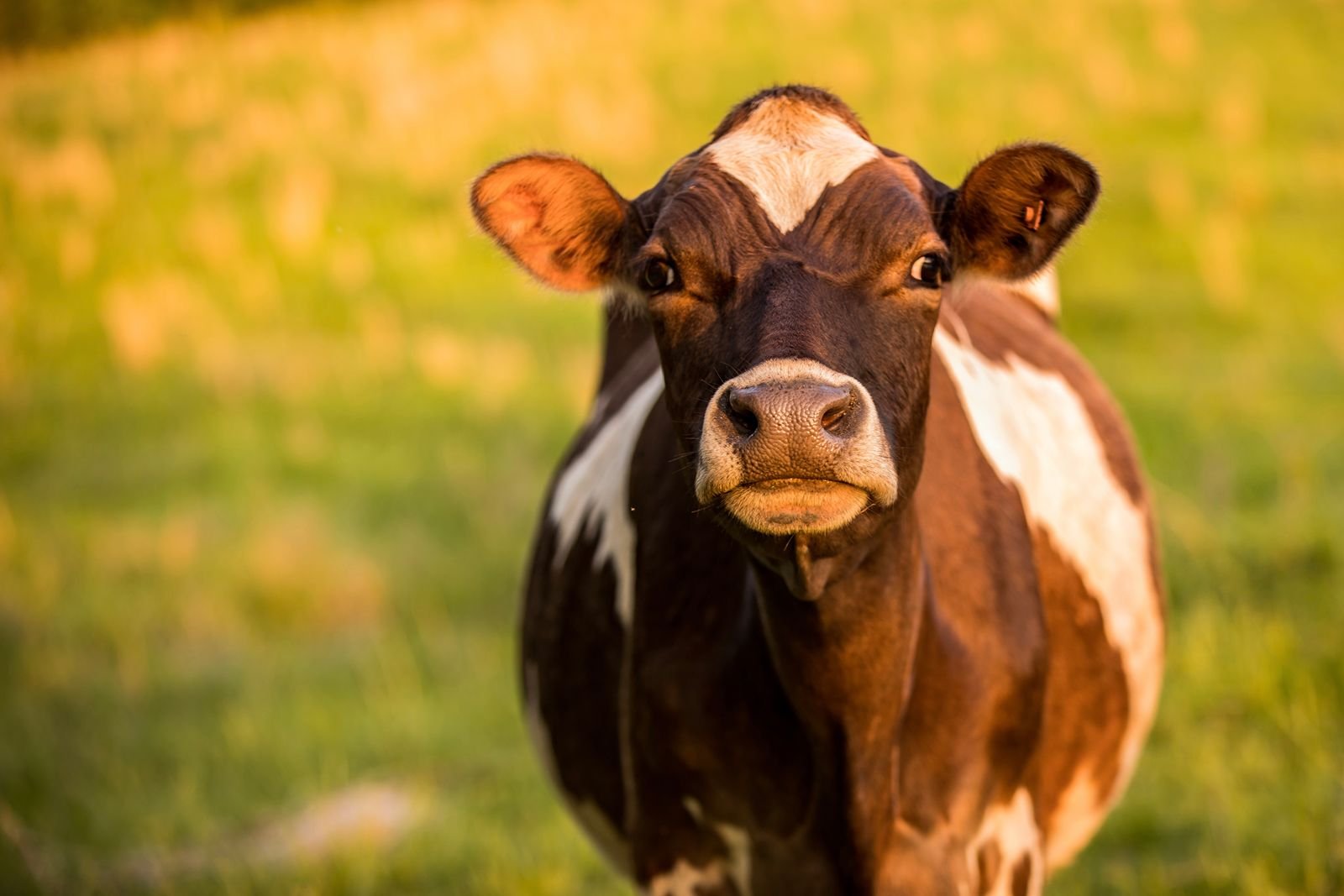
Long before I had any intention of starting a farm, all I wanted was better milk for my own family. It was the early 2000s; I had a fresh copy of Jo Robinson's Pasture Perfect, and I'd joined Joann Grohman's Keeping a Family Cow online community. The idea that how an animal is raised could actually change the food it produces put me on a mission to find a grass-fed dairy cow. I searched high and low, and that search ended up being the start of Moxie Farms (you can read the full story here).
Twenty years later, I’m still keeping grass-fed dairy cows, but these days, more and more people think that a dairy cow can’t stay healthy without grain. Those people aren’t completely wrong, but they’re blaming the wrong thing.
Why you can’t just feed any cow 100% grass
People ask us some version of the same question all the time: can't you just feed any dairy cow grass and call her grass-fed?
It's a completely reasonable question. If a cow eats grass instead of grain, isn't that... grass-fed?
But surprisingly, not every dairy cow does well without grain. Some can eat nothing but pasture and hay their entire lives and stay healthy, get pregnant every year, and produce good milk. Others on that same diet will fall apart within a season. The difference has little to do with what specific breed a cow is, and an awful lot to do with generations of breeding for the traits that matter for grass-fed dairy.
So, can you just take any dairy cow, put her in a pasture full of grass, and call her grass-fed? Technically, yes. But you probably won't have a healthy cow — or much milk — for long.
Why so many people believe a dairy cow needs grain
If you want to whip a group of hornets into a frenzy, hop into any small farming chat group and bring up grass-fed dairy cows. There's a large and very vocal group of cow owners who believe a dairy cow can’t thrive without grain.
It wasn’t always like that. In the early years, a small group of us had cows that did well on pasture and hay, and we swapped stories about management and what to do when a cow just wasn’t working in that system (it happens). Nobody was harsh about herds managed differently. We were all just trying to be good shepherds.
Even now, when the conversation gets heated, the people holding that belief are usually reacting to something real. The popularity of keeping a family milk cow has skyrocketed over the past couple of decades, but the supply of cows suited to that job hasn't come close to keeping up. Cull cows (the ones a commercial dairy decides to sell off) get sold and resold, often without their original health or breeding records. Many end up with brand-new cow owners as "grass-fed" without actually being tested in that system, and those owners have no way of knowing the difference.
As you can imagine, a lot of those cows end up in inexperienced hands, and an onslaught of emergencies follows. New cow owners, often without access to a large-animal vet (hello, national shortage of those), turn to Facebook groups and forums for help with mastitis, milk fever, ketosis, calving problems, emaciated cows, and a whole slew of other issues, all while trying to sort through a very mixed bag of good and bad advice online.
Over time, the grass-fed dairy cow got positioned to take the fall for an industry that had boomed in popularity and become overrun with mislabeled cows, misguided shepherding, and scrambled advice. Watching thousands of those situations unfold, it's not hard to understand how people came to believe that taking grain away from a dairy cow is dangerous.
I don't think they were wrong about what they were seeing; they just had the wrong culprit. A cow that falls apart without grain isn’t usually struggling because she has no grain; she's struggling because she was never the kind of cow that could do this in the first place.
It starts with the cow
Dairy cows fall into all kinds of categories, but for simplicity's sake I'm going to divide them into two: those that can truly thrive without grain, and those that can't.
And when I say thrive, I don't simply mean stay alive and give some milk. I mean a cow that stays healthy and keeps her weight on while giving a reasonable amount of milk. She also has to get pregnant reliably, carry and deliver a calf, and then do it all over again year after year — relying mostly on excellent pasture and stored forage.
To understand why some cows can do that and others struggle, you have to understand what we've spent generations asking dairy cows to do.
Historically, cattle were much more likely to be dual-purpose animals. A family needed a cow that could raise a calf, provide extra milk for the house, maintain herself on what the farm could grow, and still produce offspring with enough muscle to be useful for meat. Over time, dairy cattle were increasingly bred for one specific job: producing more milk.
As breeders began selecting cows mainly for higher milk production, the cows themselves changed. They became leaner, putting more of their energy into the milk bucket, and supporting that much milk often took a more energy-dense diet: more grain, less forage. A cow’s rumen (the largest part of her stomach) adapts to what she eats. On a forage-heavy diet, it grows large, which is what gives a grass-fed cow her round, barrel-shaped look. On a grain-heavy diet, it’s smaller and works very differently. Switching from one to the other takes time and an experienced farmer, and even then, not every cow can make the change.
But not every herd went in that direction. Some farmers continued breeding cows with a stouter frame that could maintain good body condition on pasture and quality hay, and still put plenty of milk in the bucket.
The tradeoff was production. A modern commercial dairy cow can produce an astonishing amount of milk. A cow from the older, grass-based genetics might produce roughly half as much. On paper, that makes her the lower-producing cow.
But that depends entirely on what you're asking the cow to do.
For our farm, gallons have never been the only measure of a good dairy cow. I need a cow that can take the grass we grow during the grazing season and the forage we put up for winter and turn it into plenty of milk while still taking care of herself. She has to do that every year, calf after calf. Three or four gallons of milk a day from a cow that can do that is far more valuable in our system than seven or eight gallons from a cow whose nutritional needs we can't meet without bringing concentrated feed into the equation.
And that's where years of breeding for your environment really starts to matter. You can't always tell which cows will thrive without grain just by looking at them. You have to see how they perform, how well they maintain themselves, and whether they can keep it up. Those are the cows you build a herd around.
The traits we select for in our grass-fed dairy herd
The cows I found in Tennessee more than 20 years ago gave me a tremendous head start, because I wasn’t starting with commercial dairy genetics and trying to make them fit a grass-based system. I was starting with cows that had already been selected to work in one. But those original cows were only the beginning. Since then, each generation has been another chance to keep the traits that work here and move away from the ones that don’t.
By the time one of our heifers (a young female who hasn’t had a calf yet) is growing up, I usually have a good idea of what kind of cow she's going to become. We select for a shorter, wider, more rugged frame rather than the tall, lean dairy frame most people picture when they think of a milk cow. I look for a wide muzzle, a balanced face, a deep brisket (the chest area), balanced feet and legs, and a slick coat once she sheds her winter hair. After breeding this way for so many generations, we honestly don't see many of those leaner, dairy-framed heifers anymore.
But there's another part of raising these cows that has nothing to do with how they look.
Our heifers stay with their mothers for four to six months, growing up within the herd and learning how to graze from the cows around them. They learn what to eat, where to find it, and how to move through a pasture selecting the forage they need. A motivated grazer is incredibly valuable in a grass-based dairy herd. We used to have the occasional picky cow that simply wasn't great at making use of what was available to them. After more than 20 years of selecting and raising replacements within this system, we really don't have those cows anymore.
All of this matters because a truly grass-fed dairy cow isn't created by simply taking the grain away. She's the product of generations of genetics selected for the job, raised within a herd that knows how to graze, and managed in a system designed to give her what she needs.
Grass isn't just grass
Of course, having the right cow is only half the equation. If you're going to ask her to produce milk, stay healthy, and have a calf every year without grain, you'd better give her something pretty exceptional to eat.
When I say our cows are grass-fed, it probably conjures up an image of cows standing in a green pasture eating, well, grass. The reality is much more diverse. Our pastures are a mix of native grasses, like big bluestem, switchgrass, and Indian grass, along with legumes like partridge pea and clover we’ve added over the years.
But apparently no one told the cows that "grass-fed" means they're only supposed to eat grass.
They trim the low-hanging leaves from our oak and Osage orange trees, nip the tops off wild carrots and thistles, eat the tops of spiky amaranth, and happily make use of plants most people would simply call weeds. Given the opportunity, a cow is remarkably good at moving through a diverse pasture and finding what she wants and needs.
That diversity doesn't disappear when the grazing season ends. We stockpile forage in the pastures for the cows to graze into the colder months and feed round bales of native prairie hay along with non-GMO alfalfa hay through the winter. Other than minerals, salt, kelp, and water, that forage is their entire diet.
So when I say our dairy cows are 100% grass-fed, I don't mean we took a dairy cow, put her in a field with some grass, and stopped feeding grain. The cow herself has been selected for generations to thrive in this system, and the land she lives on has to provide the diversity and quality of forage that lets her do it.
What ends up in the milk
So what does all of that have to do with the milk? Well, quite a lot, actually.
What a dairy cow eats can change the nutritional composition of her milk. The genetics we’ve spent decades selecting for, the diverse pastures those cows graze all summer, and the forage they eat through the winter are all part of that picture. And it brings me right back to the reason I went looking for a grass-fed dairy cow 20 years ago: the milk.
Research comparing milk from cows on a near-100% forage diet to conventional milk has found higher levels of omega-3 fatty acids and conjugated linoleic acid (CLA), along with a lower (better) ratio of omega-6 to omega-3 fats than what you'd get from grain-fed milk. Studies on pasture-fed dairy cows have also found higher levels of antioxidants and fat-soluble vitamins, including beta-carotene and vitamins A and E.
Vitamin K2 is another interesting one. Full-fat and fermented dairy products, particularly cheese, can contain this form of vitamin K, which plays a role in bone health. And it’s another naturally occurring component of the full-fat milk, cream, butter, and cheeses our cows produce.
There's one more genetic trait worth mentioning here. Every cow in our herd is genetically tested for her beta-casein type, and we maintain an A2/A2 herd. A1 and A2 are simply different variants of one of the primary proteins in cow's milk, and a growing body of research suggests milk containing only A2 beta-casein may be easier for some people to digest — though the science is still developing, and not every study agrees. I'm not particularly interested in convincing anyone whether A2 matters to them or not. If it does, we've already done the work of testing our cows and maintaining those genetics in the herd.
None of this happens by accident. It's the cow, what she eats, how she was raised, and generations of decisions made long before the milk ever makes it into the jar.
Grass-fed is a system, not a diet
Can you just feed any dairy cow grass and call her grass-fed? Technically, sure. But if you want a cow that thrives on that diet, you need a cow who was selected for it, generation after generation. And you need pasture and forage diverse and abundant enough to support her.
Take away either one, and the whole thing falls apart. That's the part that tends to get lost in conversations about grass-fed dairy: it’s about much more than just the grain. It's about the cow, the land, and years of paying attention to both.