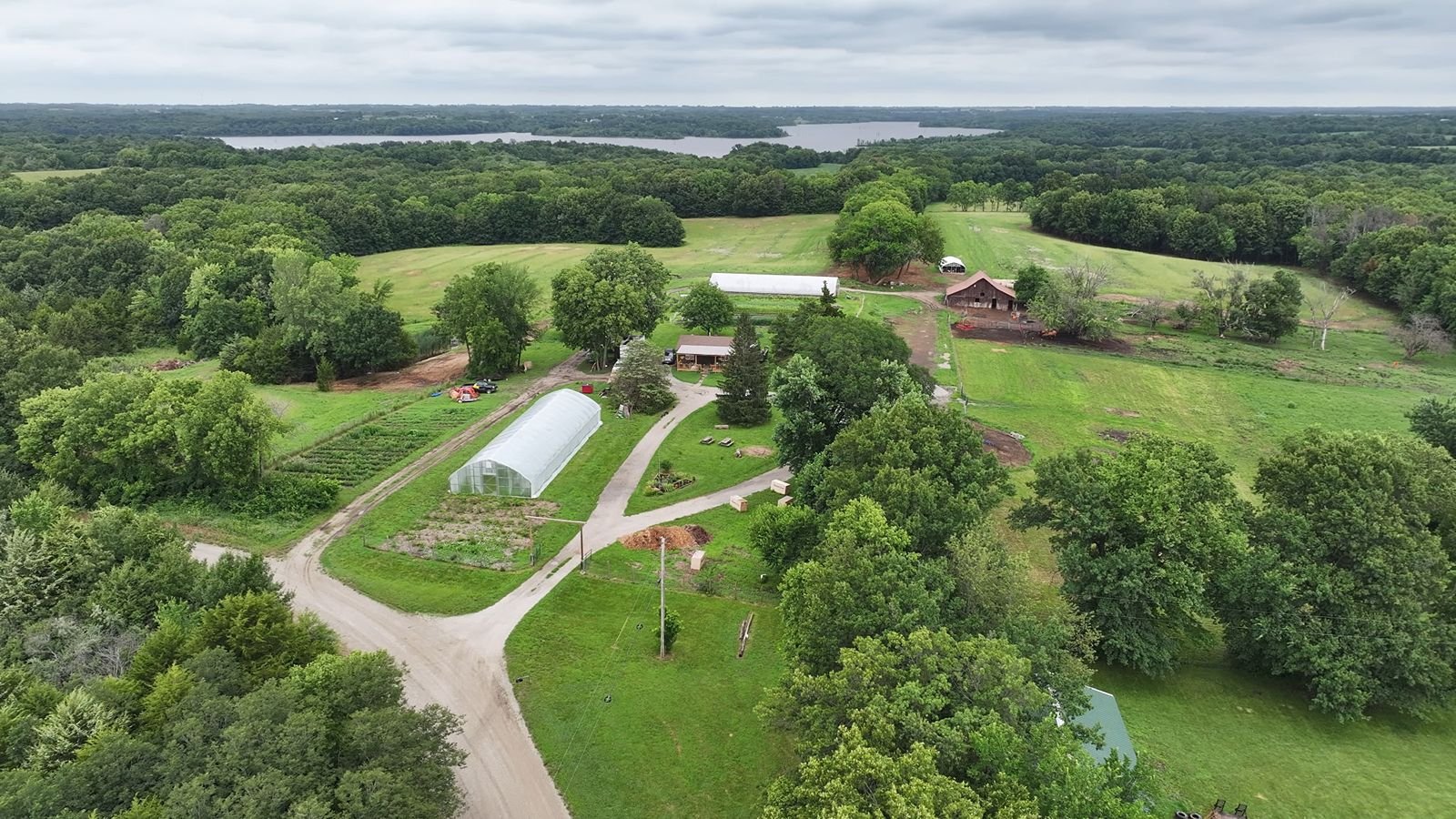
“Regenerative” has become one of those words you see everywhere: on packaging, on menus, on company websites. But it's hard to know what a farm that calls itself “regenerative” is really doing differently.
Every harvest takes something out of the soil. Farming regeneratively means making sure more goes back in than comes out, so the land rebuilds itself over time instead of slowly wearing out. On our farm, healthy soil sits at the center of it all. The way we manage our animals, gardens, and pastures — even how we plan our year — is all about helping that soil get a little richer every season.
What regenerative farming is
Regenerative farming leaves the land in better shape every year.
The term was coined in the early 1980s by Robert Rodale, whose father helped found the American organic movement. He used it to describe farming that goes beyond “sustainable.” Sustaining means keeping things as they are. Regenerating means actively rebuilding — so the soil, water, and everything living on the land end up healthier than before.
Soil comes first
There's no official definition of regenerative farming. That's part of why the word gets stretched so far. But most people who practice it agree on where it starts: with the soil. The USDA's Natural Resources Conservation Service sums it up in five soil health principles:
Keep the soil covered, so it isn't baking in the sun or washing away in the rain
Disturb it as little as possible
Grow a wide variety of plants
Keep living roots in the ground for as much of the year as you can
Bring animals onto the land, since their grazing and manure help build the soil
How is “regenerative” different from “organic”?
In the US, “organic” is a legal term that means a farm follows certain rules set by the USDA. Those rules ban synthetic pesticides and fertilizers (apart from specified exceptions), GMOs, and sewage sludge, and require farmers to manage soil fertility through crop rotation, growing cover crops (plants that protect and improve the soil between harvests), and adding materials like compost and manure to the soil.
Regenerative farming isn’t defined by a single set of rules. Instead, the focus is on the outcome: is the land getting healthier? Many regenerative farms, ours included, apply some of the same practices as organically certified farms do, like feeding the soil naturally and leaving synthetic chemicals out. There is an overlap, but the two terms don’t mean the same thing.
A piece of land that can feed its community
To us, regenerative farming means nurturing a piece of land that can feed its community.
Land that feeds that many people has to be treated like an athlete, with good nutrition, smart management, and proper rest. The more you ask of it, the better you have to feed it, manage it, and let it recover.
The questions behind that idea have been on my mind from the very beginning. How many people can a single piece of land feed, while the land itself keeps getting better? How do you grow as much food as possible from one place while also building topsoil, increasing variety, and making room for wildlife?
Not long after our first dairy cows arrived, I asked a local artist to paint my ideal farm. Not the farm we had at the time, but the one I was aiming for. More than 20 years later, the farm we have today resembles that painting in many ways. It isn’t an exact copy, but much of what she painted is out there in the fields now.
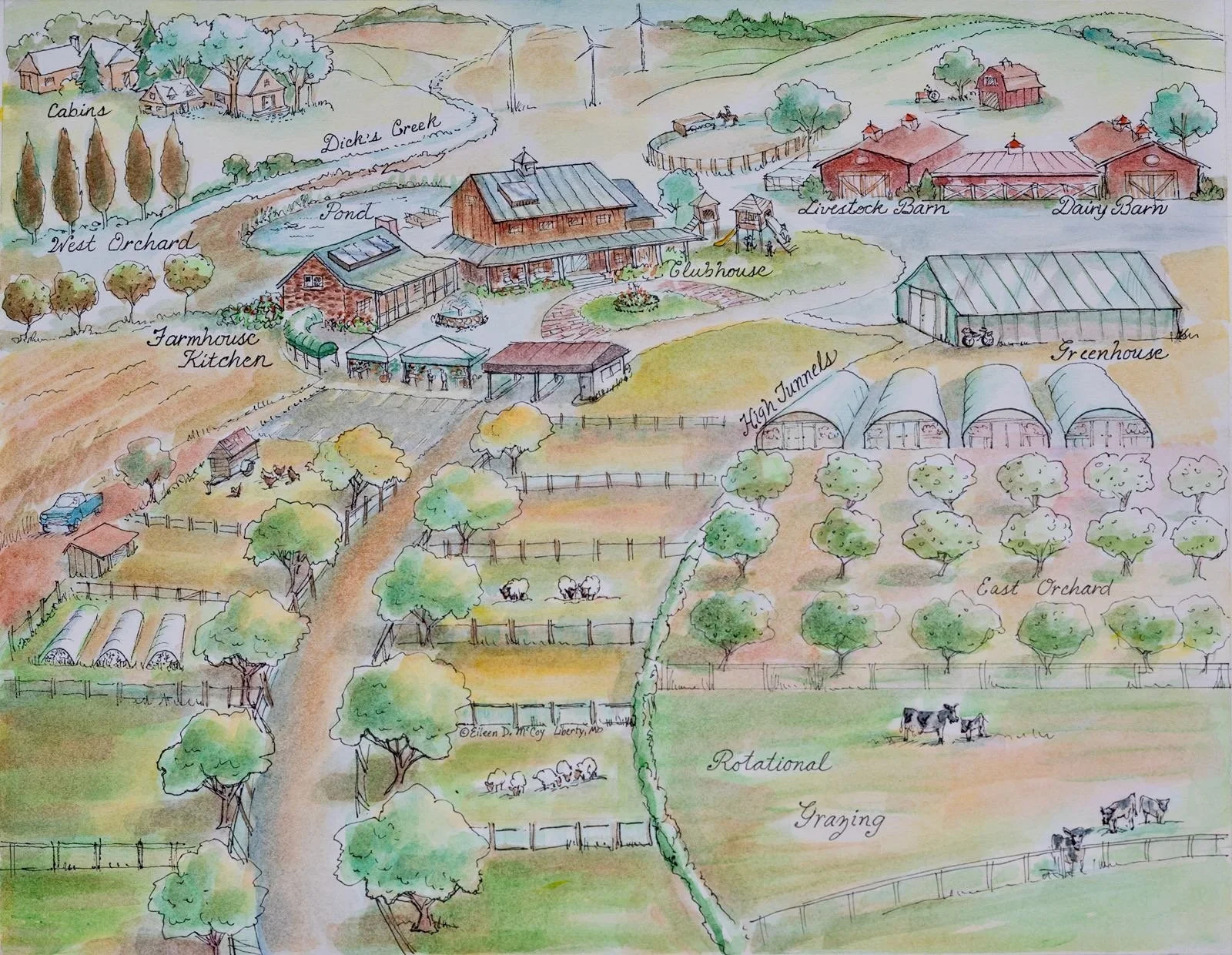
Most of what led us toward that picture came from watching nature. Walk through any wild place, whether that’s a national park or an untouched stretch of woods, and you won't find a single crop growing in neat rows. You'll find grasses, trees, creeks, and ponds, insects and birds, grazers and predators, all sharing the same ground and keeping each other in balance. A field growing one crop, year after year, never felt like the best environment for the soil, or for anything else living on it. So variety became the backbone of how we farm.
What it looks like in practice
Over 23 years, that idea has grown into a whole system, and we’ve made plenty of changes along the way. Here's what it looks like on our farm today.
How we build healthy soil
Nutrient-rich soil is the foundation for growing nutrient-rich food, and so much of a vegetable's flavor comes from the ground it grows in.
In our gardens, we don't turn the soil over. Our walk-behind tractor only stirs the top inch or so, leaving the worm paths and underground networks of fungi intact. Those networks help plant roots take in water and nutrients, and plowing the soil would tear them apart.
What comes out of the soil, we put back in. A hungry crop like sweet corn pulls a lot of nutrients from a bed, so once it's harvested, that bed often gets a cover crop instead of another vegetable. The cover crop grows for a while and is then left to break down right where it stood, returning nutrients and organic matter to the soil before anything else is planted there. Every other year or so, we also spray raw milk from our cows on the pastures to feed the life in the soil. That milk contains nutrients that soil bacteria and fungi can use, giving the underground ecosystem a little extra nourishment.
Finally, our gardens are laid out with walking paths and growing beds, so nobody walks on the beds. Every footstep would compress the soil, squeezing out the air and water that roots and soil life depend on. Push your hand into one of our garden beds, and it will sink deep into rich, dark, crumbly soil.
Every animal has a job
Every animal on this farm was brought in for what it does for the land, not just for what it produces. The goats keep fence lines and brush under control, and happily eat invasive plants that cattle won't touch. The hogs dig out the roots of Johnson grass, a tough and fast-spreading weed. Together, the hogs and goats are our land-clearing crew: they keep the shrubby, overgrown strip between the woods and the pastures from creeping into the grazing land.
The birds came in the same way: the chickens to help with flies around the cows, and the ducks to protect the orchard and berry patches from Japanese beetles. Then we brought in honeybees to pollinate the orchard and gardens. We kept bees for four years before harvesting any honey at all.
Eggs, honey, and meat are wonderful side benefits, but every animal here earns its place by helping the farm work as a whole.
Animals on the move
Our grazing animals move around the farm using something called management-intensive grazing. The idea is simple: animals graze one section of pasture for a short time, then move on, so each section gets a long rest to regrow.
The only permanent fences on our property run around the outside. Everything inside is temporary electric fencing, because sometimes the cows need half an acre, and sometimes they need three. It depends on the season, how much rain we've had, and what's growing in that pasture. No chart can make that call for you. It takes walking the pastures every day and looking closely at the ground, the insects, and the animals that just came off it.
As the cows graze, their hooves press dead plant material into the ground, and their manure returns much of what they've eaten to the soil. The chickens and turkeys follow behind them, breaking up the cow pies and eating the fly larvae. When the flies get really bad, the ducks join in too. They're even more determined fly hunters, and will pick flies right off the cows' bellies, which is hilarious to watch.
Working with nature instead of spraying pesticides
When insects show up in the gardens, our first question isn't "what kills these?" It's "why are they here, and where can we interrupt their life cycle?" In our experience, insects tend to go after the weakest plants — not the strongest, healthiest ones. So sometimes the answer is feeding the soil. Sometimes it's bringing in beneficial insects that prey on the pest. And sometimes it's changing how a plant is grown by pruning it or growing it up a trellis, so it no longer offers pests the sheltered hiding spots they're looking for.
We also grow trap crops: plants that pests love even more than the crop we're trying to protect. Blue Hubbard squash, for example, pulls insects away from the zucchini. We keep the squash netted until it’s loaded with bugs, then we open up the netting, and the birds can have a feast.
The longer we've farmed this way, the fewer common pest and disease problems we've run into.
Close to a full circle
You may have heard the term "closed-loop system" — a farm where nothing goes to waste because everything gets reused. We're not quite there, but we're working on it. On this farm, nearly everything becomes something else.
The whey left over from cheesemaking goes to the pigs, and so do the spent green bean plants. Blemished apples and extra spring greens help fatten our hogs in their last few weeks, which makes for exceptional pork. Scraps and imperfect produce either become a prepared food or feed an animal. Everything is processed here on the farm, and almost no waste gets hauled off the property. The animals produce the compost that feeds the gardens, and the land grows most of what the animals eat.
All of this runs on a master calendar for the whole year. Our dairy cows give birth in two groups, timed with the spring and fall bursts of grass growth, so there's always enough milk to go around, plus extra in spring and fall for cheesemaking. We plan for piglets to be born when there's whey to feed them, and again when apples and winter squash are coming in. Each part of the farm is timed to benefit the others, rather than to squeeze the most out of any single product.
That's also why our dairy cows raise their own calves, rather than being separated from them shortly after birth (as is common in dairy farming). We only milk them for what's left over, which means a lot less milk for us. It's a trade we're happy to make: we would much rather see calves grow up alongside their mothers than on a bottle.
It has to work for the farmer too
It's something the small-farming world often overlooks: we have to look after the people doing the work, too. A system that wears out the farmer isn't sustainable, however good it is for the soil or the animals.
So we plan the workload along with everything else. Only half of our dairy cows are milking during the heat of summer, so there’s less cheesemaking, which frees up time for canning season. We plan the gardens with the harvest in mind, too. Sweet corn never goes next to okra, because nobody in this family is willing to walk down a row with itchy plants on both sides.
From the outside, all of this can look overwhelming, and there were certainly tough years along the way. But once the right systems are in place, the workload, the soil, what the land produces, and the farm's finances all balance each other out.
Why it matters for what's on your plate
So what does all of this mean for the food itself?
First, flavor. Food grown in healthy soil, picked when it's ready, and eaten close to where it was grown simply tastes better. A nutrition bar could contain every nutrient you'd ever need, but if it tastes like cardboard, nobody will want to eat it. Food should taste wonderful and be as nourishing as possible.
Second, nutrition. The idea that healthier soil grows more nourishing food isn't new. Much of how we think about soil goes back to William Albrecht, a soil scientist at the University of Missouri, who spent decades in the 20th century studying how soil health shapes the health of the plants grown in it, and of the animals and people who eat them. One recent study comparing farms across the US found that crops from regenerative farms had higher levels of certain vitamins, minerals, and beneficial plant compounds than the same crops grown on neighboring conventional farms.
Third, you don't have to take our word for any of it. Families who belong to our food membership pick up their food here every week. They see the farm, the animals, and the greenhouse each time they come, and they can ask us anything. Being able to have a relationship with the person who grows your food and with the place that food comes from is something you won’t get from a grocery store label.
Putting in and getting back
For us, that's the whole idea behind regenerative farming: a loop. You put care and work into the land, and it gives back, as long as you don't cut corners.
Good land stewardship means putting the health of the soil, the environment, and the wildlife first, rather than only focusing on how much the land can produce. Done well, it means one piece of land can feed a whole community. That's the farm in that painting, and it's the one we keep working toward.